
Observe, Don’t Absorb
How to stay present without carrying what isn’t yours


Someone I love asked me a question recently.
Should I go?
That’s all it was.
A simple question about whether to meet up with someone.
But I didn’t hear it as a question.
I heard it as a problem I needed to solve.
So I did what I always do.
I leaned in.
I started thinking for her.
I ran through the variables, the risks, the patterns I’d seen before.
I gave her my answer.
Clear. Direct. Protective.
The kind of advice I thought a good friend gives.
She thanked me.
Then she did exactly what she was going to do anyway.
Because she’d already decided before she ever asked me.
She wasn’t looking for my opinion.
She was looking for validation.
And when I didn’t give it to her, she just found another way to justify the choice she’d already made.
When I found out what she had done, I wasn’t upset at her.
I was upset at myself.
Because I’d done it again.
Stepped into a role no one asked me to play.
I thought I was being supportive.
What I was actually doing was inserting myself into a decision that was already made.
And that brought on resentment.
Not because she didn’t listen.
But because I gave freely, expected nothing, and still somehow felt used.

I used to believe caring meant being in it with people.
If someone brought me their problem, my job was to hold it with them.
Think it through together.
Sit in the heaviness until we found a way out.
I thought that’s what good listeners did.
I thought presence required participation.
That mirroring someone’s worry without offering a solution would feel cold. Detached. Like I didn’t care enough to help.
So I helped.
I gave advice when it wasn’t asked for.
I problem-solved when all they wanted was to be heard.
I treated every complaint like a crisis I was responsible for managing.
And I never questioned it.
Because isn’t that what empathy looks like?
Doesn’t love require you to carry what the people you care about can’t carry alone?
I really believed that.
Until I came across this TikTok.

How to Stop Spending So Much Energy on Other People’s Problems
This video of a mom giving her daughter advice named something I’d been doing wrong for years without realizing it.
Apparently, when someone is talking to you about their stuff, you don’t have to hold it for them.
You’re supposed to just hold space for it.
Mirror what you hear.
“Dang, that sounds frustrating.”
“Oof. That is hard.”
And then stop.
Don’t try to fix it.
Don’t agree harder than they do.
Don’t feed the spiral with your own energy.
Just let them sit in their own energy long enough to figure it out themselves.
What I didn’t understand before was this:
When you don’t add resistance.
When you don’t add advice.
When you don’t add your own perspective.
They’re left alone with it.
They have to wrestle with their thoughts.
Their opinions.
Their discomfort.
Not me.
Not my advice.
Not my interpretation.
They have to hear themselves clearly for the first time.

That TikTok made me realize something else too.
Those conversations were never about me.
Yes, they were coming to me.
Yes, they were asking what I thought.
But it wasn’t because they valued my opinion,
It’s because they valued theirs.
My role wasn’t to help them think.
My role was to reflect clearly enough that they could think.
I wasn’t supposed to solve their problems.
I was supposed to hold up a mirror.
And that’s it.
Not cold.
Not detached.
Not indifferent.
Just not mine to solve.
Now I understand that there’s a difference between mirroring and merging.
Merging is what I used to do.
I’d step into their emotional field. Match their energy. Think with them.
I thought that was presence.
It wasn’t.
It was absorption.
And absorption doesn’t help anyone.
It just means two people are now sitting in the same confusion instead of one.
That’s where the resentment came from.
Unsolicited advice creates an invisible contract.
I give you my energy. You owe me change.
And when they don’t take it. When they do what they were going to do anyway.
It feels personal.
Because I overextended without permission.
Once I saw that, it got easier to stop.
Not because I cared less.
Because I finally understood that caring doesn’t require fixing.
PAUSE: The Framework I Return To When I Feel the Pull
The next time I feel the urge to fix, explain, soften, or steer, I take it as my cue to PAUSE.
That’s the reminder.
To stay curious, reflective, and grounded instead of corrective.
P — PAUSE
I stop before responding.
Long enough to notice the urge itself.
The reflex to fix or interrogate.
That brief pause gives me space to shift from judgment into curiosity.
A — Ask from Curiosity
I ask questions that open, not corner.
Not
“Why would you do that?”
But
“What’s pulling you toward that?”
Curiosity keeps the conversation safe.
It lets people feel heard instead of evaluated.
U — Understand by Reflecting
This is the part I used to skip.
Before doing anything else, I reflect back what I’m hearing.
“So it sounds like you’re torn.”
“That feels heavier than you expected.”
No insight.
No interpretation.
No steering.
Just enough reflection for them to hear themselves think.
S — Stay Out of the Spiral
Once I’ve reflected, I don’t jump in.
I don’t share a story to relate.
I don’t agree harder than they do.
I don’t rush things toward resolution.
And I don’t try to regulate their discomfort so I can relax.
I allow the discomfort to exist without fixing it.
I don’t rescue them from the tension of their own thoughts.
If I feel myself trying to manage their emotions or outcome,
that’s my cue to step back.
Advice Is Optional
If they ask for advice, I still decide if I want to give it.
And if I do, I speak from my own experience.
“Here’s what I would do.”
“This is how I see it.”
They can take it or leave it.
I don’t need to control the outcome for it to be useful.
E — Exit Cleanly
When the conversation ends, I let it end.
I change rooms.
I shake it off
And let the energy go.
This is how I protect my peace without hardening myself.
How I stay present without paying for it later.
Here’s the part I want to slow down for a moment
Like most TikToks, the real conversation was in the comments.
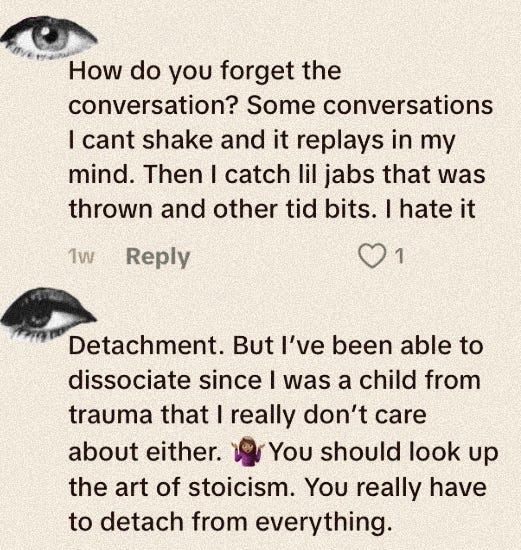
What I’m describing can look like detachment from the outside.
Especially online, where emotional restraint gets mistaken for emotional disappearance.
But detachment isn’t what I’m pointing to.
Dissociation isn’t presence.
Numbing isn’t regulation.
Forgetting a conversation because you never let it land isn’t the same thing as staying grounded while it passes through you.
There’s a difference between not absorbing and not caring.
Stoicism, when it’s reduced to “detach from everything,” misses something essential.
Actual regulation doesn’t require you to leave the room emotionally.
It asks you to stay—without merging.
That’s the distinction I’m making.
I’m not talking about checking out.
I’m talking about staying present without taking responsibility for what isn’t mine.
Observe. Don’t absorb.
That’s the reminder I return to now.
Not as a way to detach.
But as a way to stay present without losing myself in the process.

If you liked this piece you might enjoy The One Where I Didn’t Rush to Explain
Love this!